AI call centres are reshaping the way businesses talk to their customers. By leveraging an ai call centre, companies can replace long queues, repeated questions, and overworked agents with intelligent automation that answers faster, scales effortlessly, and maintains consistently high quality. According to the Metapress guide on AI call center solutions, these systems are critical for delivering seamless omnichannel experiences. For those looking ahead, ai call center: the future of customer support and sales illustrates how AI is transforming both customer service and sales operations.
This guide walks through what an AI call centre is, how it works, the key benefits, real‑world use cases, and the practical steps to launch or upgrade your own AI‑powered customer service operation.
Modern businesses don’t just need speed—they need intelligence. Tools like Flashmob Computing innovations for enterprises help integrate high-performance automation into daily operations, reducing manual workload while maintaining accuracy. By combining these solutions with advanced analytics, companies can predict customer needs and resolve issues before they escalate, a technique that’s becoming standard in top-tier AI call centres.
Another growing resource is Supercomputer Box technology for business growth, which provides scalable computing power to handle massive customer interactions efficiently. Integrating this kind of infrastructure ensures that your AI systems are not just reactive but proactive, offering smarter recommendations and faster resolutions.
Marketing and customer engagement also play a crucial role. Platforms like Marketing for Customers strategies show how personalized communication, driven by AI, can boost satisfaction and loyalty. Leveraging AI insights from your call centre helps craft messages that resonate with each customer, increasing engagement without adding extra burden on human agents.
For businesses looking to expand their reach, Marketing Runners tips for AI-driven campaigns demonstrate how combining AI call centre data with marketing automation can improve targeting and conversion rates. By analyzing call patterns and customer feedback, companies can fine-tune campaigns and ensure every interaction counts.
Financial and operational decision-making can also benefit. Websites like Top Financial Resources for small and large businesses provide guidance on budgeting for AI technology and calculating ROI. Understanding these metrics ensures your AI call centre investment aligns with growth objectives while minimizing unnecessary expenditures.
By blending AI-powered automation with strategic tools, businesses can create a customer experience that feels personal, seamless, and efficient. The future of support isn’t just about answering calls—it’s about anticipating needs, streamlining operations, and empowering teams with the right intelligence at the right time.
Top 10 AI Call Centre Solutions for Modern Businesses
AI call centres are transforming customer service by providing intelligent automation, faster responses, and data-driven insights. Choosing the right platform is essential for businesses looking to improve efficiency and customer satisfaction. Here’s a list of the top AI call centre solutions, starting with Bright Pattern.
1. Bright Pattern – AI Contact Center Solutions
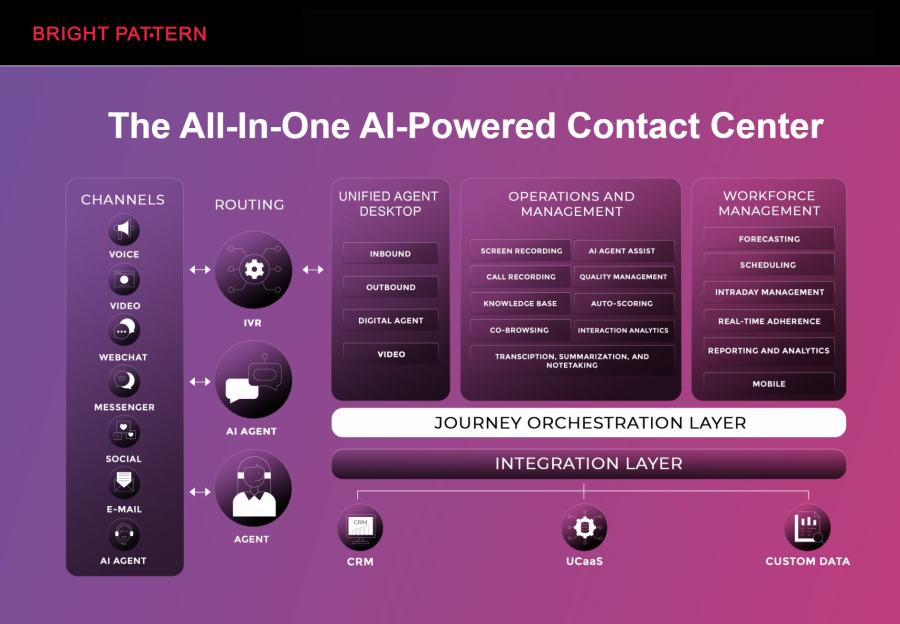
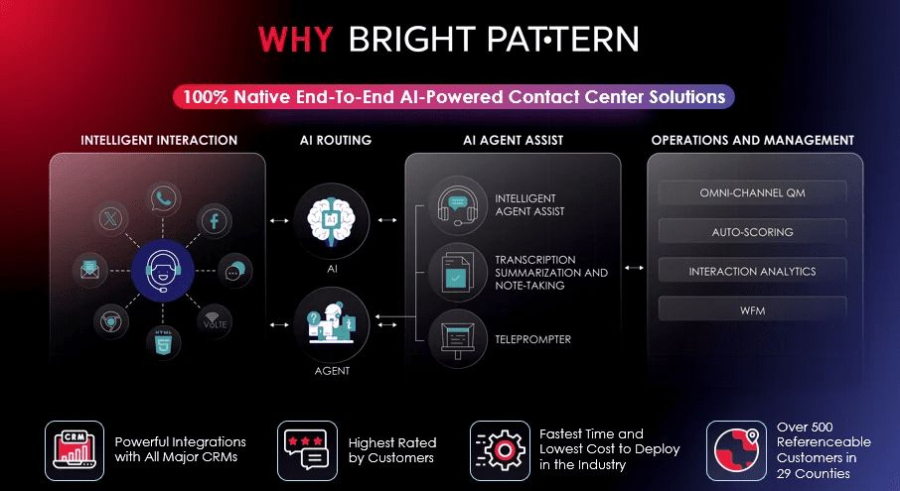
Bright Pattern offers a fully integrated AI call centre platform that helps businesses deliver exceptional customer experiences across all channels. Its cloud-based system is designed for scalability, efficiency, and real-time analytics, making it a top choice for modern enterprises.
Key features include:
- Omnichannel support across voice, chat, email, SMS, and social media
- Intelligent routing that connects customers to the best agent or automated solution
- AI-powered chatbots and virtual assistants to reduce agent workload
- Real-time dashboards and reporting for actionable insights
- Easy integration with CRM, ERP, and other business tools
Businesses using Bright Pattern benefit from faster response times, improved customer satisfaction, and better operational efficiency, all powered by AI-driven insights.
2. Genesys Cloud CX
Genesys provides AI-enabled contact center solutions that integrate analytics, workforce management, and omnichannel communication to enhance customer experiences.
3. Five9 Intelligent Cloud Contact Center
Five9 focuses on AI-powered automation and predictive dialing to streamline customer interactions and increase agent productivity.
4. Talkdesk CX Cloud
Talkdesk offers a cloud-based contact center solution with AI-driven insights, automation, and omnichannel support to deliver smarter customer engagement.
5. NICE inContact CXone
NICE inContact provides a flexible, cloud-native platform with AI capabilities for routing, analytics, and automated workflows.
6. Avaya OneCloud CCaaS
Avaya combines AI and cloud technology to create personalized, efficient customer interactions while improving agent performance.
7. RingCentral Contact Center
RingCentral’s AI-powered platform integrates voice, messaging, and digital channels with smart routing and analytics for seamless customer service.
8. 8x8 Contact Center
8x8 delivers AI-assisted automation, real-time reporting, and multi-channel communication to improve agent efficiency and customer satisfaction.
9. Cisco Webex Contact Center
Cisco Webex provides a cloud-based solution with AI-driven analytics, virtual agents, and omnichannel routing for better customer engagement.
10. Zendesk Sunshine Conversations
Zendesk offers AI-powered chatbots and messaging integration, allowing businesses to deliver proactive and personalized customer support across multiple channels.
What Is an AI Call Centre?
AnAI call centreuses artificial intelligence technologies to automate and enhance customer interactions over phone and digital channels. Instead of relying only on human agents, AI call centres combine:
- Virtual agentsthat can understand and respond to customers in natural language.
- Intelligent routingthat sends each customer to the right resource at the right time.
- Agent assist toolsthat support human agents in real time with suggestions and knowledge.
- Analytics and reportingthat turn every conversation into actionable insight.
In practice, this can mean an AI voice bot that answers the phone 24/7, a chatbot on your website or messaging apps, and a smart dashboard that helps your human team respond better and faster.
How Does an AI Call Centre Work?
AI call centres are built on several core technologies that work together to deliver natural, effective conversations.
1. Speech Recognition and Natural Language Understanding
When a customer calls and speaks,automatic speech recognitionconverts spoken words into text. Then,natural language understandinganalyzes that text to identify:
- The customer’s intent (for example, pay a bill, change an appointment, get product help).
- Key details such as names, dates, amounts, order numbers, or locations.
- Sentiment signals, such as whether the caller sounds frustrated, confused, or satisfied.
2. Decision Engines and Workflow Automation
Once the system understands what the customer wants, adecision enginefollows business rules and workflows to resolve the issue. This can include:
- Looking up account or order details.
- Triggering processes such as refunds, password resets, or appointment changes.
- Escalating to a human agent when needed, with full context.
3. Natural Language Generation and Text-to-Speech
To respond, the AI builds a natural language answer usingnatural language generation, then usestext‑to‑speechto turn that answer into a human‑like voice over the phone. For chat or messaging channels, it simply sends text back to the customer.
4. Integration With Your Existing Systems
An AI call centre becomes far more powerful when it connects to your business systems, such as:
- Customer relationship management platforms.
- Order and billing systems.
- Ticketing and helpdesk software.
- Scheduling and calendar tools.
This allows the AI to personalize responses, complete real transactions, and keep records fully updated without manual work.
Key Benefits of an AI Call Centre
AI call centres deliver advantages across customer experience, operations, and business performance. Below are the most impactful benefits.
1. 24/7 Availability Without Extra Headcount
AI does not sleep, take breaks, or go on vacation. An AI call centre can provideround‑the‑clock supportwithout the cost of overnight shifts or expanded staffing. Customers can get answers and complete routine tasks at any time, which is especially valuable for global audiences or time‑sensitive services.
2. Shorter Wait Times and Faster Resolution
Virtual agents can handle many calls simultaneously, eliminating long queues for common questions. Even when a human agent is required, AI can complete initial data collection and verification so that agents start each conversation with full context, reducing average handling time and speeding resolution.
3. Consistent, High‑Quality Service
AI follows your best practices every time. Scripts, compliance rules, and knowledge bases can be baked directly into the system, deliveringconsistent responsesregardless of volume, time of day, or agent experience. This reduces the risk of errors and ensures customers receive the same high standard of care.
4. Lower Operational Costs
By automating a large share of repetitive and low‑complexity interactions, AI call centres help:
- Reduce the number of calls that require human agents.
- Shorten call durations when humans are involved.
- Improve first‑contact resolution, which cuts follow‑up calls and tickets.
These efficiencies free your team to focus on complex, high‑value interactions and allow you to scale without linearly increasing headcount.
5. Better Employee Experience
Call centre work can be highly repetitive and stressful. When AI takes over routine tasks and data entry,human agents spend more time on meaningful, problem‑solving interactions. This can increase job satisfaction, reduce burnout, and make training more focused on relationship‑building skills rather than rote processes.
6. Deeper Insights From Every Conversation
AI call centres automatically capture and analyze interaction data. Over time, this gives you a rich view of:
- Common customer questions and pain points.
- Demand peaks by time of day, day of week, or season.
- Customer sentiment trends across products or regions.
- Agent performance and training opportunities.
These insights help you improve products, refine processes, and continuously optimize the customer journey.
Popular Use Cases for AI Call Centres
AI call centres can serve almost any industry. Here are some of the most common and impactful use cases.
Customer Service and Technical Support
- Answering frequently asked questions about accounts, orders, and policies.
- Walking customers through troubleshooting steps for common issues.
- Resetting passwords and unlocking accounts with secure verification flows.
- Providing order status, delivery updates, and return instructions.
Sales and Lead Qualification
- Qualifying incoming leads by asking structured questions.
- Scheduling demos or consultations directly into your team’s calendar.
- Providing product recommendations based on stated needs.
- Following up with prospects after initial inquiries.
Appointments and Reservations
- Booking, confirming, and modifying appointments.
- Sending reminders and capturing confirmations or cancellations.
- Managing waitlists and notifying customers when slots open.
Billing and Payments
- Answering questions about invoices and charges.
- Taking secure payments through automated flows.
- Setting up or modifying payment plans and due dates where policies allow.
Proactive Outreach and Notifications
- Notifying customers about service outages or maintenance.
- Sharing renewal reminders or policy updates.
- Following up after service interactions to check satisfaction.
AI Call Centre vs Traditional Call Centre
AI does not replace the need for human agents in every situation, but it greatly changes the mix of work. The table below summarizes key differences.
| Aspect | Traditional Call Centre | AI‑Augmented Call Centre |
| Availability | Limited by staffing hours and shifts. | 24/7 for many interactions, with humans on demand. |
| Scalability | Requires hiring and training more agents. | Virtual agents scale quickly to handle volume spikes. |
| Consistency | Varies by agent skill, fatigue, and turnover. | Standardized responses and workflows for common tasks. |
| Cost Structure | Primarily labor‑driven and linear with volume. | More automation, lower marginal cost per interaction. |
| Employee Focus | Many repetitive, low‑value calls and data entry. | Complex, high‑value conversations and relationship building. |
| Insights | Often limited to manual sampling and spot audits. | Full‑interaction analytics and sentiment tracking. |
Implementing an AI Call Centre: Step‑by‑Step
Launching an AI call centre does not have to be overwhelming. A structured approach keeps risk low and results visible.
Step 1: Define Clear Goals and Success Metrics
Start by deciding what you want AI to achieve. Common objectives include:
- Reducing average handle time.
- Improving first‑contact resolution.
- Lowering call abandonment rates.
- Extending support hours without increasing headcount.
- Improving customer satisfaction scores.
Translate each objective into measurable metrics and define a baseline so you can track improvement over time.
Step 2: Map Customer Journeys and Identify High‑Impact Use Cases
Analyze incoming interactions to find patterns:
- Which issues occur most frequently?
- Which tasks are repetitive and rules‑based?
- Where do customers face the longest wait times?
- Which interactions cause the most frustration or churn?
The best starting candidates for AI are common, low‑complexity interactions with clear rules for resolution. Automating these frees your team to focus on more nuanced situations.
Step 3: Choose Channels and Interaction Types
Decide where AI will engage customers first:
- Voicefor inbound or outbound calls.
- Chaton your website or mobile app.
- Messagingthrough popular messaging platforms.
- Email assistanceto draft responses for agents.
You can start with one channel and expand as your team gains confidence and customers respond positively.
Step 4: Select the Right Technology Partner or Platform
Evaluate AI call centre platforms based on:
- Quality of speech recognition and natural language understanding.
- Ease of integration with your existing systems.
- Tools for building and updating conversation flows.
- Analytics and reporting capabilities.
- Security, privacy controls, and compliance features.
- Support, training, and ongoing service from the provider.
Step 5: Design Conversations and Workflows
Collaborate across customer service, operations, and compliance teams to design:
- Conversation flows that feel natural and customer‑friendly.
- Clear routing rules for when to escalate to human agents.
- Verification and security steps for sensitive actions.
- Fallback scenarios when the AI is not confident in its understanding.
Use real customer phrases and examples to train and refine the system, rather than relying only on internal assumptions.
Step 6: Pilot, Measure, and Iterate
Run a limited pilot before full rollout. During the pilot:
- Monitor completion rates and customer satisfaction.
- Review transcripts to spot confusion and friction.
- Adjust phrasing, prompts, and routing based on feedback and data.
Iteration is key. AI call centres become more effective over time as you refine them with real‑world usage.
Features to Look For in an AI Call Centre Solution
Not all AI call centre platforms are created equal. When assessing options, consider prioritizing the following capabilities.
Robust Natural Language Capabilities
- Support for multiple languages and accents where needed.
- Ability to handle interruptions, clarifications, and digressions naturally.
- Continuous learning from new phrases and patterns.
Omnichannel Orchestration
Customers move fluidly between channels. Look for systems that can:
- Maintain conversation context across voice, chat, and messaging.
- Offer seamless handoff from AI to human agents with full history.
- Keep customer profiles consistent across all touchpoints.
Agent Assist and Supervisor Tools
- Real‑time suggestions and knowledge snippets for human agents.
- Automatic summaries of calls and tickets.
- Live dashboards for supervisors to monitor queues and sentiment.
Security, Privacy, and Compliance
Customer trust is essential. Evaluate how the platform handles:
- Encryption of calls, transcripts, and stored data.
- Access controls and audit trails.
- Data retention, redaction, and deletion policies.
- Region‑specific regulations that apply to your industry.
Best Practices for a High‑Performing AI Call Centre
Beyond technology choices, success with AI depends on how you design, manage, and continuously improve your operation.
Keep the Human in the Loop
AI should amplify your human team, not replace it. Make it easy for customers to reach a person when:
- The issue is emotionally sensitive or complex.
- The AI is not confident in its understanding.
- The customer explicitly requests a human agent.
Ensure handoffs are warm, with context and history visible to the agent so customers do not have to repeat themselves.
Design With Empathy
Technical accuracy is not enough. Effective AI call centres are designed with an understanding of how customers feel when they reach out. Use:
- Clear, jargon‑free language.
- Polite, concise prompts and confirmations.
- Affirmations that show understanding of the customer’s situation.
Where appropriate, sentiment detection can adjust responses and routing when frustration or distress is detected.
Invest in Training and Change Management
Your frontline team is crucial to the success of AI. Provide training on:
- How the AI system works and where it excels.
- How to interpret and use AI‑generated suggestions.
- How to give feedback on AI performance and gaps.
Position AI as a supportive tool that removes busywork rather than a replacement, so your agents feel engaged and empowered.
Continuously Monitor Quality
Quality management does not end with launch. Establish an ongoing process to:
- Review sample interactions regularly.
- Track key metrics such as containment rates, transfer rates, and satisfaction.
- Update workflows and knowledge based on policy changes or new offerings.
The Future of AI Call Centres
AI call centres continue to evolve rapidly. Looking ahead, you can expect:
- Even more natural, human‑like conversations, including better handling of nuance and context.
- Deeper personalization as systems leverage unified customer profiles and history.
- Stronger collaboration between AI and human agents, with AI handling more of the preparation and follow‑up.
- Richer analytics that connect contact centre performance to broader business outcomes such as revenue and retention.
Organizations that invest early and thoughtfully in AI call centre capabilities gain a structural advantage: they serve customers faster, learn from every interaction, and scale without sacrificing quality.
Bringing It All Together
An AI call centre is more than a chatbot on a phone line. It is a strategic shift in how you design customer service: blending automation and human empathy to deliver reliable, round‑the‑clock support.
By starting with clear goals, focusing on high‑value use cases, selecting the right platform, and committing to continuous improvement, you can build an AI‑powered call centre that delights customers, empowers employees, and drives measurable business results
